Building Better Sight-Readers with Sight Reading Factory and the MusicFirst Classroom

Today at the Iowas Music Educators Conference in Ames, Iowa, I am presenting a session titled Sight Reading Tips for Every Situation - the first time I’ve ever presented it. Whenever I have a new session to deliver, I spend HOURS crafting the sequencing of the session, as well as the slide deck - and this one was no different. And to be honest, getting a blog post out of this as well is a bonus :). This session called for me to not only highlight how MusicFirst can help music teachers help their students become better sight readers - it also called for practical pedagogical tips. That made me think, because for as long as I’ve been teaching and working with music educators, sight reading has remained one of the most essential (and often most challenging) skills we develop in young musicians. Whether it’s preparing a middle school band for festival or helping a high school choir confidently tackle new repertoire, strong sight-reading is foundational to musical literacy. Yet teachers repeatedly tell me they lack the time, differentiated materials, and consistent structure needed to truly build fluency.
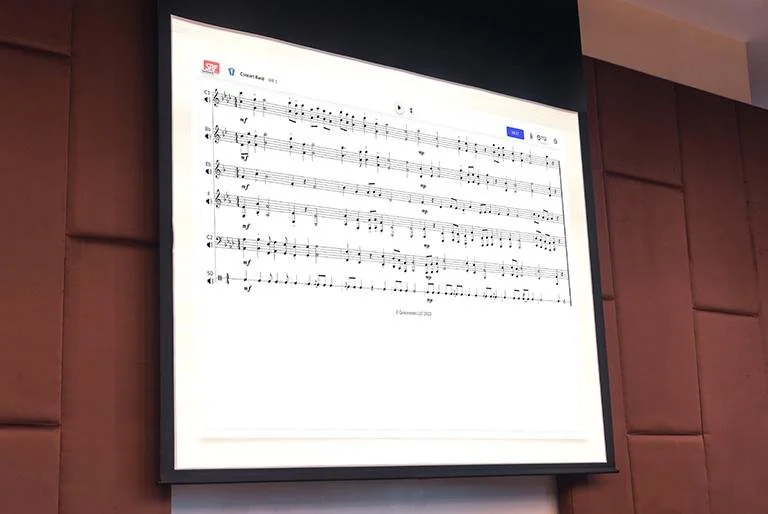
This is precisely where technology, when applied with intention, can transform instruction. Sight Reading Factory (SRF), fully integrated into MusicFirst Classroom, offers both the pedagogical grounding and practical flexibility needed to make sight-reading a daily, achievable habit for all ensembles. The combination of unlimited, leveled exercises with a structured digital workflow gives teachers the resources they’ve been missing and gives students the repetitions and feedback necessary to grow.
The most effective sightreading instruction still begins with strong fundamentals: audiation, rhythm syllables, pattern recognition, and a brief but purposeful study period before playing. These time-honored strategies don’t disappear with technology - in fact, SRF reinforces them. Because every exercise is unique, students can’t memorize or rely on rote patterns; they must truly think ahead and apply the literacy tools you’ve taught.
Using SRF as a quick daily warm-up transforms sight-reading from a high-stakes event into a routine part of musicianship. A one-minute rhythm pattern or short melodic line customized to your ensemble’s abilities - helps students build consistency without taking away precious rehearsal time.
One of the biggest challenges teachers face is the wide skill range within any ensemble. SRF’s customization features - difficulty levels, instrument ranges, rhythmic vocabulary, keys, and meters - make differentiation not only possible, but easy. In MusicFirst Classroom, teachers can assign leveled exercises to individuals or groups, all within the same workflow and rubric structure. Beginners work on stepwise motion while advanced players tackle more complex intervals; everyone receives an exercise appropriate to their skill set. Because SRF generates fresh material each time, every student receives an authentic sight-reading experience, every attempt.
A major advantage of working within MusicFirst Classroom is access to the Content Library, which includes complete sight reading units, lessons, and assessments for band, choir, and orchestra. These materials scaffold literacy from basic rhythms through full ensemble reading. Teachers can assign a complete unit or integrate individual lessons into their existing curriculum. The included rubrics, teacher guides, and festival-style assessments save hours of planning and create a coherent instructional sequence. This pairing - SRF’s generative power and the Content Library’s structured pedagogy - gives teachers a turnkey solution for building musical literacy.
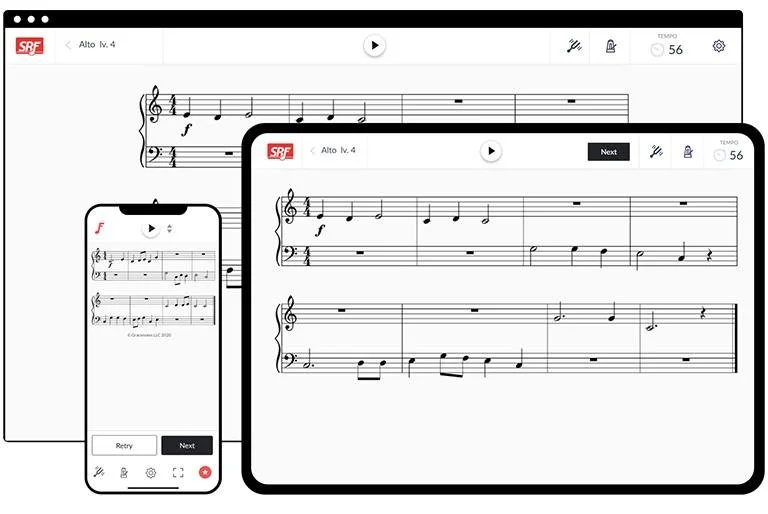
Strong sight-reading isn’t just about performing in the moment; it’s about developing self-awareness and resilience. In MusicFirst Classroom, students record SRF assignments directly in the platform. Listening back, evaluating their own performance, and reviewing teacher feedback helps them internalize what went well and what needs attention. Over time, students begin to recognize patterns, recover from mistakes more confidently, and approach new music with less anxiety.
For directors preparing students for adjudicated events, SRF allows you to recreate the experience with remarkable accuracy. You can match difficulty level, rhythmic vocabulary, key signatures, study time, and performance expectations used in your region. Combined with sight-reading units from the Content Library, students walk into the sight-reading room knowing exactly what to expect - musically and procedurally.
The real power of Sight Reading Factory and MusicFirst Classroom lies in their ability to support what great music teachers already do. By giving educators unlimited material, differentiated instruction, built-in lessons, and consistent feedback tools, they make it possible to teach sight reading effectively, even in the face of limited rehearsal time and diverse ensembles.
So my suggestion for building better sight readers? Make SRF a daily habit, explore the Content Library’s scaffolded resources, and watch your students become more confident, independent, and musically literate - one exercise at a time. If you’d like to get a FREE 30-day trial of SRF and the MusicFirst Classroom, just sign up here!