AI Tool: Detect Music
Generative artificial intelligence (AI) is becoming part of everyday music creation - whether we like it or not. Students are experimenting with AI tools such as Udio and Suno for composition, and many music educators that I have spoken with about AI during my numerous sessions and keynote addresses surrounding this topic find these tools and this topic to be the most distressing. Is the future of music going to be filled with music created by AI? I certainly hope not. At the same time, streaming platforms, publishers, and educators are asking an important question: How do we know whether a piece of music was created by a human or generated by AI? There are now numerous examples of fake bands and musical arists all over Spotify. A new, free tool called DETECT.MUSIC, developed by MatchTune, aims to help answer that question. The service is designed to analyze music tracks and determine whether they are likely AI-generated, and in some cases identify which AI engine may have been used. For music educators, this tool is worth paying attention to, not because it solves every problem around AI, but because it helps clarify an increasingly blurry landscape.
Many teachers are now encountering student work that may involve AI in some way. This might include compositions created with generative tools, AI-assisted backing tracks, or music generated entirely from prompts. I tell every music teacher that will listen that if you give your students a written assignment, you should assume that nearly everything that students turn in will be generated by AI. While AI can be a useful creative aid, schools still need to make clear distinctions between original student work, assisted work, and fully automated output. Detection tools like DETECT.MUSIC can support conversations about authorship, transparency, and academic honesty. They are not about “catching” students, but about helping teachers and learners understand how AI fits into the creative process.
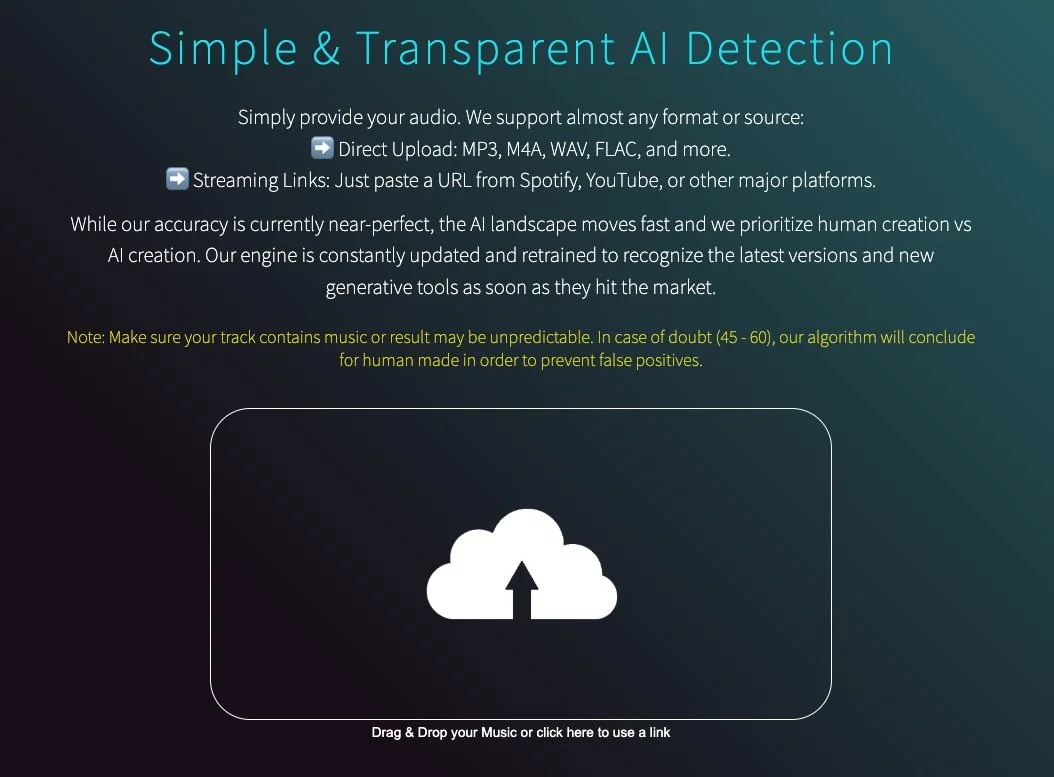
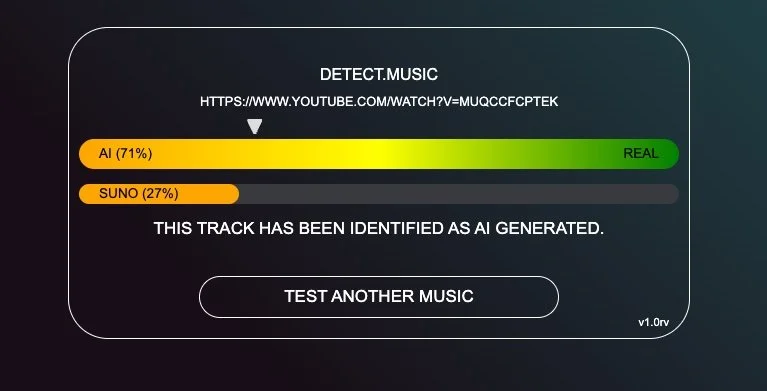
DETECT.MUSIC is intentionally simple to use. Teachers or students can upload an audio file or provide a link from platforms such as Spotify or YouTube. The system then analyzes the track and reports whether it shows characteristics associated with AI-generated music. And the best part? The service is completely free - at least for now. This lowers the barrier for teachers who want to explore AI detection without committing to paid software or complex workflows. You can test example tracks, student submissions, or even your own recordings to see how the system responds. One of MatchTune’s stated goals is to help artists avoid having their music incorrectly flagged as AI-generated when uploading to streaming platforms. I decided to test the tool out with two songs, one by the AI “artist” Xania Monet and one by one of my favorite bands, Goose. This is the track from Xania titled “How Was I Supposed to Know” that I uploaded to DETECT.MUSIC:
This track is 100% generated by AI. Here is the result of the AI detection from DETECT.MUSIC:
Hooray! It works. Now here one of my favorite tracks by the band Goose titled “Hungersite”:
I know that this track is 100% real. Here is the result of the AI detection from DETECT.MUSIC:
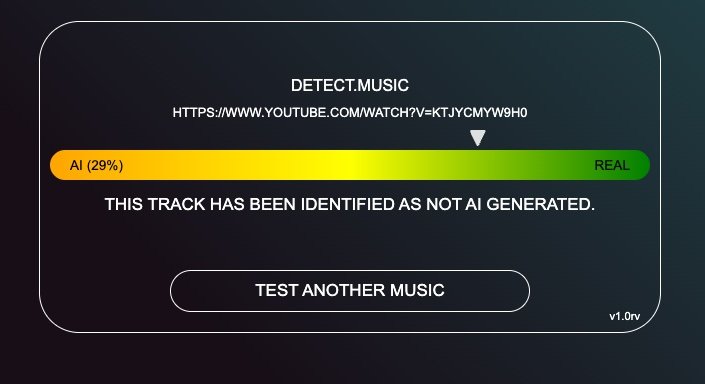
Hooray! It got it correct again. VERY impressive IMHO.
For educators, I think that this tool raises a useful teaching point. Students preparing portfolios, college submissions, or public releases need to understand that how music is labeled and classified can affect visibility and credibility. Tools like DETECT.MUSIC can be used to introduce discussions about digital identity, metadata, and how algorithms influence music distribution. It’s important to be clear: AI detection is not perfect. No tool can offer absolute certainty, and results should be interpreted as indicators, not final judgments. DETECT.MUSIC should be viewed as a reference tool that supports decision-making, not replaces professional or educational judgment. That said, having access to a free, easy-to-use detector gives educators another data point when evaluating work or designing assignments that involve technology.
As AI continues to influence music creation, educators need practical tools—not hype—to help navigate change. DETECT.MUSIC does not take a strong stance for or against AI. Instead, it provides information that can support clearer conversations with students about creativity, ethics, and responsible use of technology. For music teachers looking to stay informed without becoming overwhelmed, this is a really useful place to start.