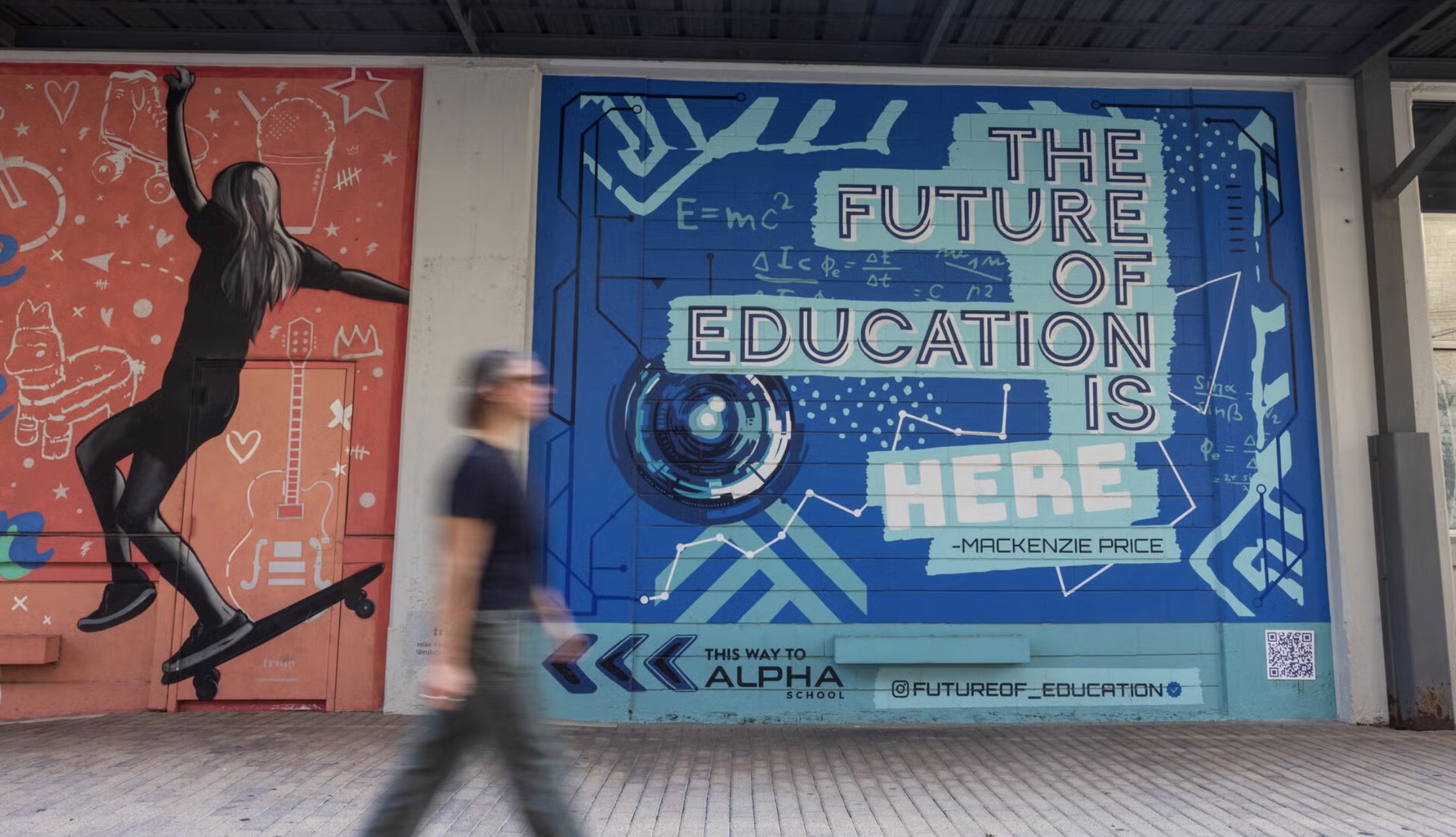
This past weekend read an interesting and somewhat troubling New York Times article about Alpha School, a rapidly expanding network of private schools attempting to fundamentally rethink K–12 education through artificial intelligence. I wrote a previous blog post about this school network when I first learned about it this past summer. In that post I raised several concerns about this radical GenAI teaching model and it seems that many of them - after only a month or two of operations - have come true. As someone who spent 15 years teaching in public schools and has subsequently devoted my entire career to educational technology, I approached the article with considerable interest. I came away with more concerns than enthusiasm.
Here's how it works: Students spend approximately two hours each morning learning traditional academic subjects like math, reading, and science using AI-powered software. The technology adapts to each student's abilities and allows them to progress at their own pace. The rest of the school day is spent on projects, life skills, and other activities. Perhaps most alarmingly, Alpha doesn't employ traditional classroom teachers at all. Instead, students work with adult "guides" who provide support and motivation while the software handles academic instruction.
Alpha claims students can learn twice as much in a fraction of the time. That's a pretty bold statement, and according to the Times article, their own internal data suggests that approximately half of their K–8 students aren't meeting that goal in mathematics. There are several things about this approach that bother me.
First, Alpha is an expensive private school, with tuition reportedly reaching $75,000 annually. It's difficult to compare the results of a school serving a relatively small, self-selected group of students with those of public schools that are required to educate everyone. Public schools serve students with a wide range of abilities, learning challenges, and family circumstances. I'm not convinced this model could work nearly as well in that environment.
Second, I'm concerned about the amount of time students spend learning independently through screens. Anyone who has taught knows that learning isn't always a straightforward process. Students ask unexpected questions, misunderstand concepts, get distracted, and sometimes need a teacher to explain something three different ways before it finally makes sense. I'm skeptical that AI, or a “guide” for that matter, can consistently handle those situations as effectively as an experienced educator.
But what does the data show so far on the efficacy of this type of education model? According to the Times, only 42% of Alpha's K–8 students achieved the promised doubling of their learning rate in both math and reading. About 20% failed to meet the reading target, and roughly half fell short in math. Among students who started at or below the national median in math, just 37% achieved the promised growth rate. And the results from Alpha's expansion into public education aren't particularly encouraging either. At its Arizona charter school, Alpha projected that 65% of students would demonstrate proficiency in English and 60% in math. The actual first-year results were 28% and 10%, respectively. In another partnership with a struggling Texas charter school, the percentage of students performing at grade level in state testing reportedly dropped from 10% to zero. These are different measures across different schools, and not all of these outcomes can be attributed solely to Alpha's software. Still, for an organization making such extraordinary claims about the effectiveness of its approach, I would expect considerably better results. But I’m honestly not surprised.
I'm never going to be sold on the idea of replacing teachers with guides, and I think that a huge reason for the lackluster results so far are attributable to this. Teachers do much more than deliver content. They build relationships, recognize when something isn't right with a student, encourage curiosity, and help children learn how to interact with others. Those things are difficult to measure, but they're incredibly important. And what about the long-term impact? Will students who spend years learning primarily through software develop the same problem-solving, communication, and social skills as students in more traditional classrooms? We simply don't have enough evidence to know.
I do think AI has an important role to play in education. Tools that provide personalized practice, immediate feedback, and assistance with lesson planning can be incredibly valuable. I've spent much of my career advocating for technology that helps teachers do their jobs more effectively. But that's very different from suggesting that technology should take over the teaching itself.
I also wonder where subjects like music, art, and physical education fit into this model. The article makes no mention of them. We all know that these are areas where students learn by doing things together, making mistakes, and working with teachers and classmates. I would hate to see them treated as activities that simply fill the hours after the "real" academic work is finished.
Ultimately, I think Alpha School is an interesting experiment, but I'm doubtful it represents the future of education. I am also glad that my own children aren’t serving as guinea pigs for it. The costs, questions about student development, and lack of convincing long-term evidence are significant concerns. Before we start talking about replacing teachers with AI and reducing academic instruction to two hours a day, perhaps we should first demonstrate that this approach actually works better than what we already have. So far, I'm not convinced.
What do you think?