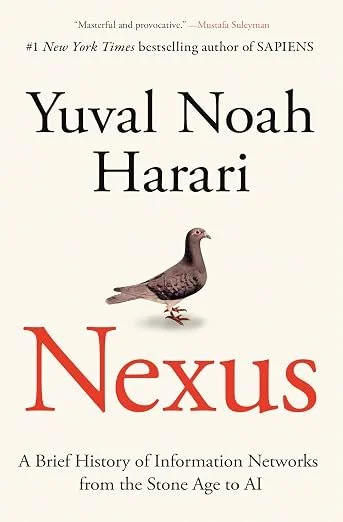
I just finished reading Nexus: A Brief History of Information Networks from the Stone Age to AI by Yuval Noah Harari, the author of Sapiens and Homo Deus. While I haven’t read any of his previous books, my daughters bought this one for me for my birthday (they know me pretty well). The book certainly gave me plenty to think about, especially when it comes to the future in general when considering the potential impacts of generative AI on all aspects of our lives: from our government, privacy, social media, etc. I’m not going to lie - I found this book pretty frightening at times when you consider the many things that could go wrong now that artificial intelligence has been let out of the box. But because I am at my core a music educator, I always try to apply what I’m reading in these types of books to the classroom, and specifically any potential impacts to education, music education, and the potential impact generative AI is going to have on what we teach and how we teach it. The main idea of Nexus is that information networks have shaped human civilization throughout history. From the earliest forms of communication to the printing press, newspapers, radio, television, and eventually the internet, our ability to share information has fundamentally changed how societies function. But Harari makes an interesting point that we sometimes overlook. Just because we have access to more information doesn't mean we're necessarily getting smarter or making better decisions. History is full of examples of information being used to manipulate people rather than enlighten them.
Harari believes that AI represents something very different from the technologies that came before it. Until now, information technologies have largely been tools that humans use to communicate and share ideas. AI is different because it can actually create new content, make decisions, and increasingly act without human direction. That's a pretty significant development when you stop to think about it. As always, I found myself thinking about what all of this means for music teachers. We've been using technology in music classrooms for decades. For the most part, these technologies have helped students do things they were already learning to do. Generative AI changes that relationship because the technology can now do much of the creative work itself.
Consider how that might affect music education. Until recently, music technology generally required students to make the musical decisions. A notation program could play back a composition, but the student still had to write the notes. A digital audio workstation could record and edit a performance, but someone still had to create it. Generative AI changes that relationship. A student can now ask a system to compose, arrange, or produce music without necessarily making many of the musical decisions themselves.
This brings me to another of Harari's concerns: the possibility that humans will gradually surrender decision-making to AI systems because they are faster, more convenient, and often appear more knowledgeable. In music education, I think that's something we need to watch carefully. If students begin relying on AI to make every compositional or interpretive decision, they may never develop the musical judgment that we're supposed to be teaching.
Over the next five years, I suspect we'll need to rethink how we assess student learning. Rather than simply grading a finished composition, we may need to ask students to explain why they chose certain harmonies, melodies, or instrumentation. We might have them compare an AI-generated arrangement with one they created themselves and discuss the differences. The ability to evaluate musical choices may become just as important as the ability to make them.
The author also spends a lot of time discussing the importance of trust and the institutions that help societies determine what information is reliable. I think music teachers have an important role to play here. As AI-generated music becomes increasingly sophisticated, students will need guidance in understanding where music comes from, how it was created, who owns it, and whether the information an AI system provides is actually correct. An AI-generated analysis of a Beethoven symphony might sound convincing while containing significant errors. Students need enough musical knowledge to recognize those mistakes.
Perhaps the most interesting connection to music education is Harari's warning that technological advancement doesn't necessarily lead to human advancement. Just because AI can compose a symphony doesn't mean we should stop teaching composition. Just because software can evaluate a performance doesn't mean students should stop developing their ears. And just because AI can generate a professional-sounding recording doesn't mean the experience of learning to play an instrument becomes any less valuable.
We'll also need to help students become comfortable using AI without becoming completely dependent on it. That means teaching them to recognize when AI gets something wrong, understand the ethical and copyright issues involved, and develop enough musical knowledge to make their own informed decisions. Personally, I don't believe any of this makes traditional music education less important. In fact, I think quite the opposite. Learning to sing, play an instrument, improvise, and perform with other musicians provides experiences that go well beyond producing a piece of music. There's something special about making music with other people, struggling through a difficult passage, or finally getting something right after weeks of practice. I don't see AI replacing those experiences anytime soon.
I will say that Harari tends to focus quite a bit on the potential dangers of AI, and I found myself wishing he had spent a little more time exploring its possibilities. I'm considerably more optimistic about what these technologies could mean for education, provided we're thoughtful about how we use them. I also think music educators need to resist the temptation to dismiss generative AI simply because it challenges some of our traditional approaches to teaching. We've been through technological changes before, and while this one may be considerably more disruptive, ignoring it isn't going to make it go away.
My biggest takeaway from Nexus is that technology doesn't automatically make things better. What matters is how people choose to use it. That's something I think we should all keep in mind as we prepare for the music classroom of 2030 and beyond. I'd highly recommend reading Nexus, even if you're not particularly interested in AI. It certainly made me think about where music education is headed, and perhaps more importantly, what we want it to look like when we get there.