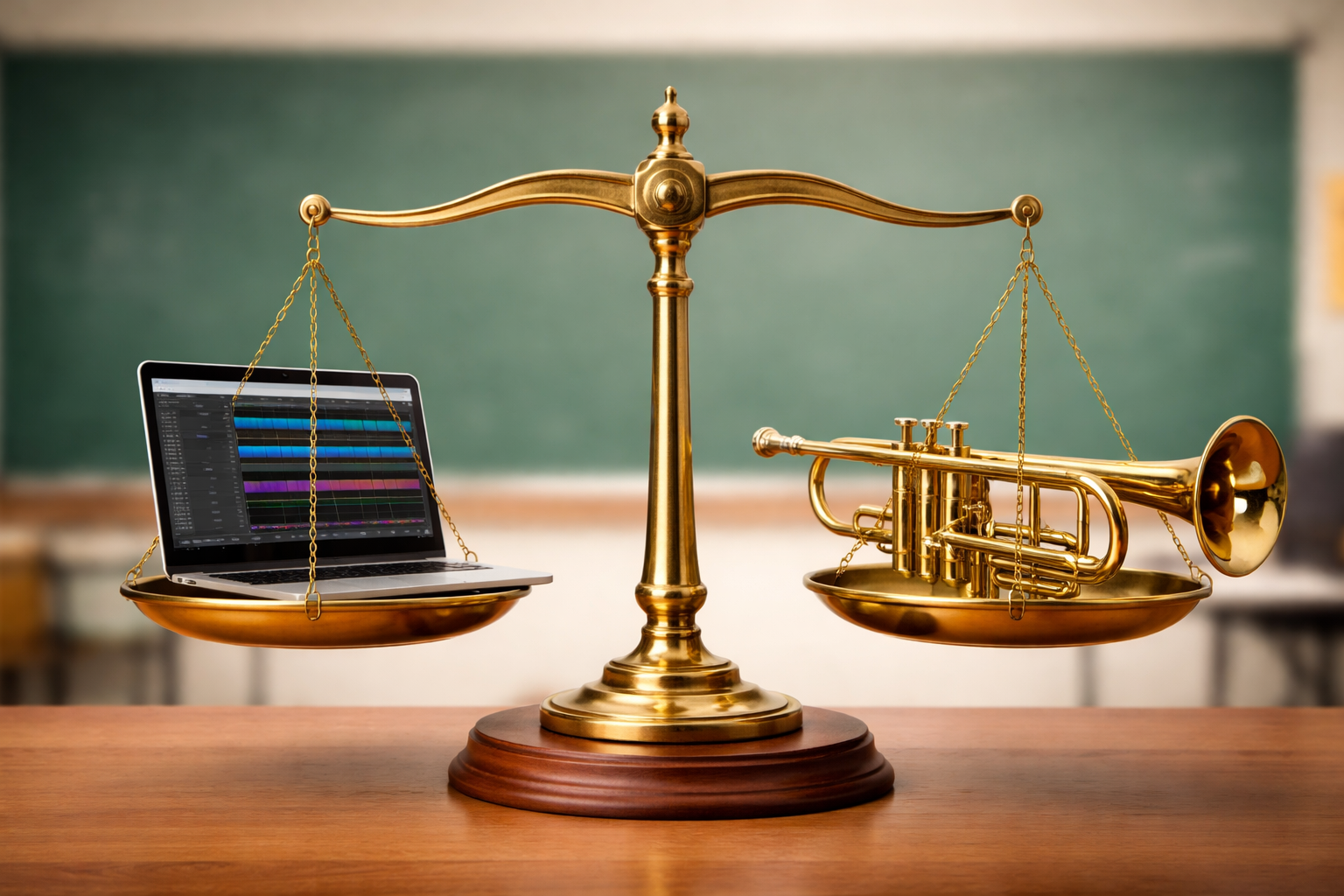
There is a moment every music teacher knows well. It’s something that I personally experience quite often. You discover a new piece of technology, a shiny new app or tool, and for a brief moment it feels like it might be the answer to everything. Engagement. Assessment. Differentiation. Grading. And then reality sets in. Some tools stick. Some do not. Some genuinely improve teaching and learning. Others quietly disappear after a semester or two. That tension is not a failure of technology. It is a reminder of what our job actually is. Technology in the music classroom should never be the point. It should always be the support.
At its best, educational technology helps us teach musical concepts more clearly, more efficiently, or more equitably. At its worst, it becomes something we use simply because it exists or because we feel pressure to prove that we are being innovative. The difference between those two outcomes comes down to intentionality. I have always said that great technology in the hands of a terrible teacher won’t help that teacher be any more engaging or effective. The best teachers around can teach without technology, obviously. I think that my dear friend Barbara Freedman said it best. “Teach music. The technology will follow.” That idea guided my thinking when I built MusicFirst and it is a philosophy that should guide every decision we make about technology in our classrooms. We are really a music education company at our core - NOT a music technology company. Many of our team members, myself included, were former teachers - and highly successful ones. We are all driven by the same mission: to help music educators to their jobs, and to make music education more engaging for students.
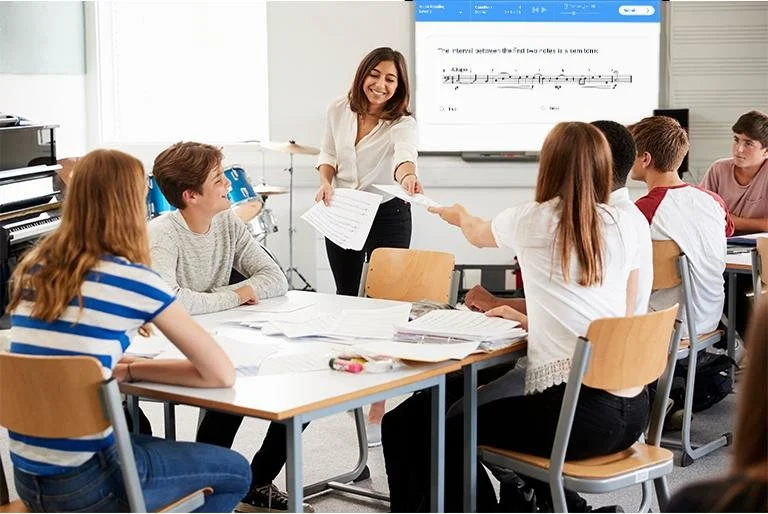
The fundamentals of music education have not changed. We are still teaching students to listen, perform, read music fluently, compose, and think critically about what they hear and create. No app or platform replaces that work. What technology can do is remove obstacles that get in the way of those goals or create new pathways when traditional approaches fall short. Sometimes technology is exactly the right tool. When students are developing aural skills, tools like Auralia provide immediate, individualized feedback that a teacher simply cannot deliver to thirty students at once. When students are learning music theory concepts, Musition allows them to practice, make mistakes, and try again without fear, all while giving teachers meaningful data about what students actually understand.
In performance based classes, PracticeFirst powered by MatchMySound, allows students to submit recordings and receive focused feedback, freeing rehearsal time for music making instead of check ins and reminders. Sight Reading Factory gives students unlimited, level appropriate sight reading material, something no method book alone can realistically provide. It can also easily fit into your usual warm up routine. After long tones, scales, and other warm-up exercises, have students sight read something, every day. Flat for Education and Noteflight empower students to compose and arrange music without getting stuck on the mechanics of notation, allowing creativity to come first.
These tools work because they serve a musical purpose. They are not there for novelty. They are there to support learning. Just as important, technology should help us reclaim time. Administrative tasks often consume hours that should be spent planning, listening, and teaching. When platforms like MusicFirst Classroom streamline rostering, assignment distribution, assessment, and grading, they give teachers something invaluable back. Time. Time to teach. Time to listen. Time to connect with students.
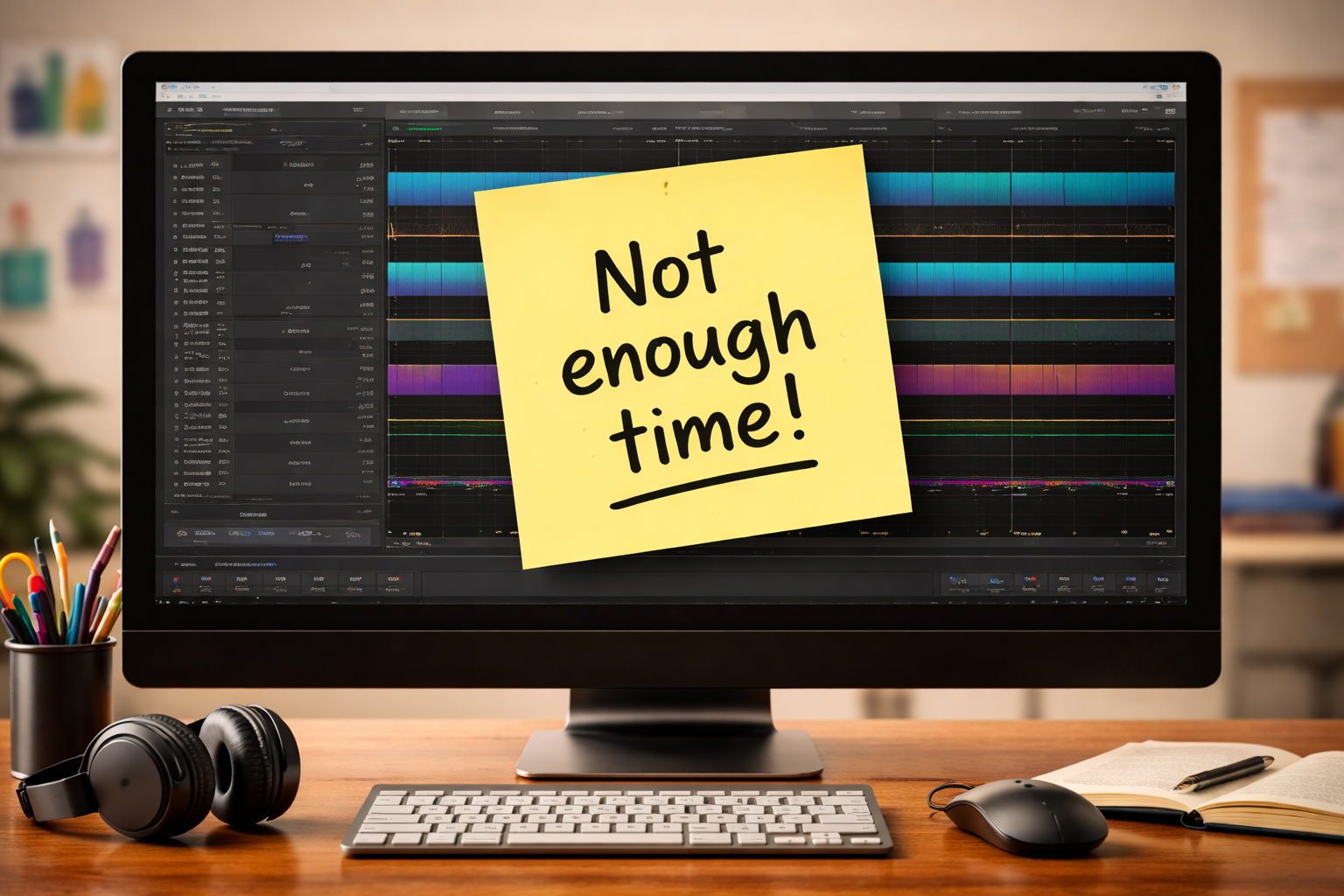
That is not accidental. MusicFirst was built around this exact idea. When I was building our platorm, I had a Post-it note on my screen at all times. It said “Not enough time”. Technology should work for teachers, not the other way around. Every tool in the MusicFirst ecosystem was designed to support musicianship and to reduce friction, not to add it.
Of course, there are moments when technology is not the right choice. There are times when singing together in the room is the best assessment. There are lessons where pencil and paper are still the most effective tools. Choosing not to use technology can be just as intentional and just as pedagogically sound as choosing to use it. Finding the balance means asking one simple question. Does this tool help me teach music better or help me get my time back so I can teach music better? If the answer is yes, use it confidently. If the answer is no, let it go. Teach music first. The technology really will follow.
If you would like to try out ANY of the software and platforms offered by MusicFirst, click HERE to sign iup for a FREE 30-day trial.