How GenAI Might Help You Find the Right Music for Your Performance Ensemble

By now, your school year is either winding down or over. When I was still teaching, I spent the last days of school figuring out the program for my winter concerts. My method? I always just went on the JW Pepper website, searched for repertoire for each ensemble, filtered down to the level of difficulty of each piece, and tried to find a balance of music so that there was something for everyone. An easy opener, a piece that stretched their abilities, one that I knew the students would love playing, and a piece or two to balance out the program. It’s really quite an important and challenging responsibility for any music educator: pick music that is too easy and the students get bored. Pick music that is too difficult and you may have to cut it (and waste your precious budget), and select music that might be controversial and you might get into a situation where you have to defend your selections. Because we are often the only music teacher in the building that teaches a specific ensemble, this process is left completely to us, and it can be a daunting task. With thousands of titles available through publishers and music retailers, finding the right piece can often feel overwhelming.
This is where GenAI tools like ChatGPT, Claude, Copilot and Gemini may become really valuable tools for music educators. While they obviously can’t replace a teacher's musical judgment and experience, they can serve as powerful assistants during the repertoire selection process. Consider the vast catalog available through JW Pepper, or any other online sheet music retailer. You can search through their MASSIVE collection of music for band, chorus, and orchestra, covering every grade level, style, and instrumentation imaginable. A GenAI tool can help educators navigate these choices more efficiently by narrowing the field based on the specific needs of their ensemble. For example, a band director might describe their ensemble as having a strong flute section, only two French horns, limited percussion resources, and students performing comfortably at a Grade 2.5 level. Instead of spending hours searching through hundreds of titles, the teacher could ask an LLM to recommend works from the JW Pepper catalog that match those criteria. The AI can help identify pieces that fit the instrumentation, technical demands, and educational goals of the ensemble.
Here is a recent interaction that I had with ChatGPT that illustrates how it can be used. Was it perfect the first time? Far from it. I had to keep prompting it until I had something I could use.
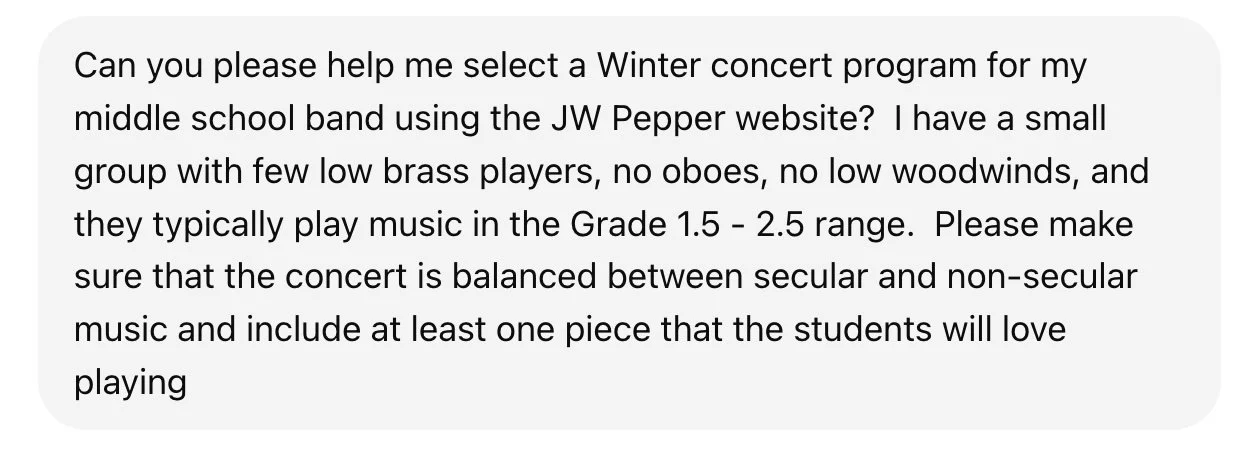
ChatGPT’s response included some selections that were way off - although the pieces themselves are terrific. I’ve edited the response down a bit for the sake of brevity, but here is the program it suggested:
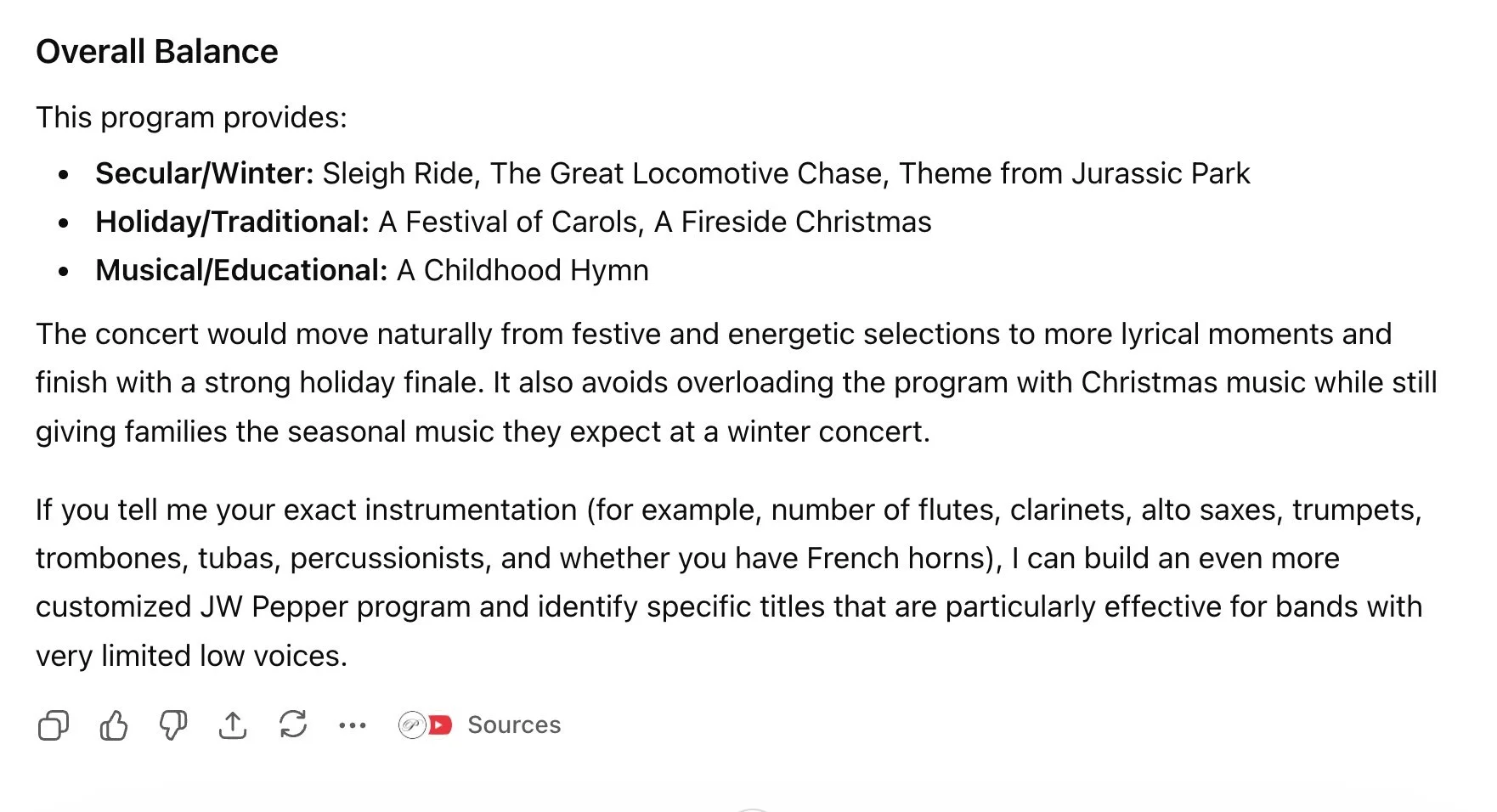
I didn’t really like the results of this first pass, so here is what I then prompted:

And this is what it came up with based on that prompt:
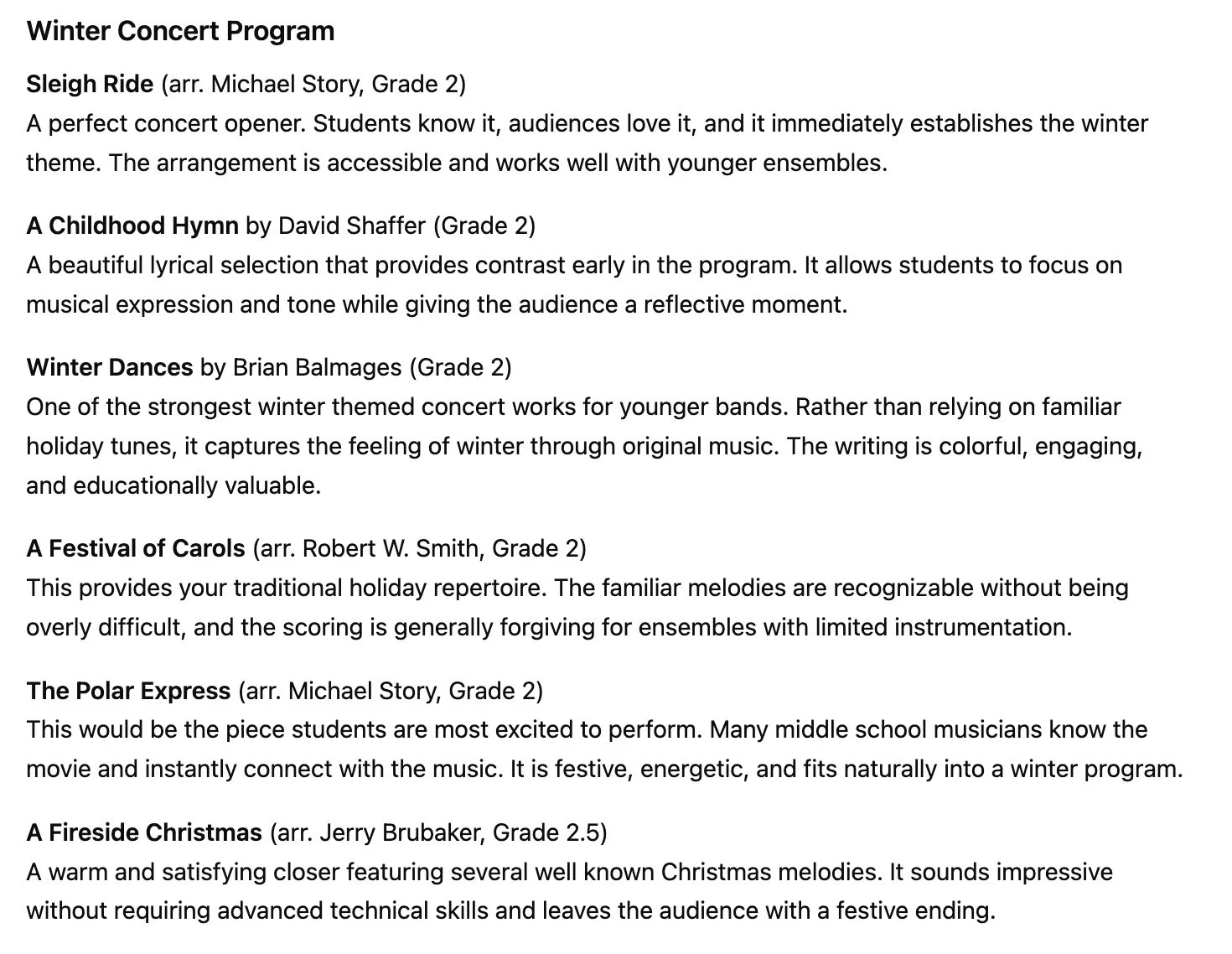
Much better - but nothing for Hanukkah. Here was my third and final prompt:

And here is the final response it gave:
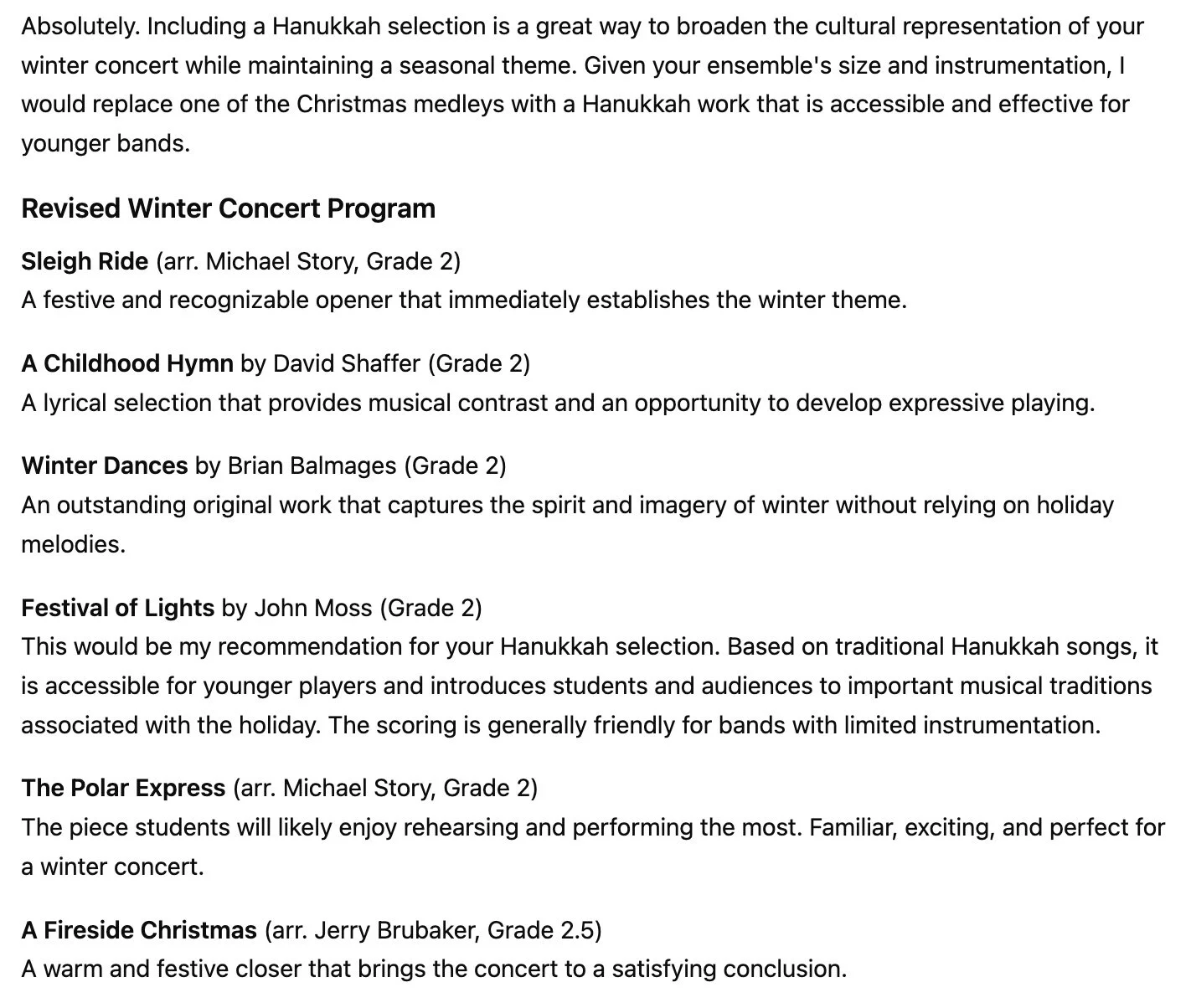
I’m pretty happy with this result. Now, could I have done this without using ChatGPT - of course! I programmed dozens of concerts without it - in fact - when I started teaching I used to use the paper version of the JW Pepper catalog exclusively. There were no audio tracks to listen to - I just went by what was written in the description. But I do think that using a tool like ChatGPT, Claude, Gemini or Copilot to help you navigate the massive catalog of available music is a perfect way to save time and come up with useful suggestions. You can do what I’ve done for any ensemble and the more descriptive your prompt, the better. I could have kept going - asking it for a completely different program with links to audio files for each so that I could preview each piece. I could also have put in the total budget that I had available so that it kept the prices within that parameter.
Ultimately, GenAI tools should be viewed as a research and discovery tool rather than a decision maker. The final choice will always belong to the teacher, who understands the unique strengths, challenges, and personalities of their students. However, by helping you sort through large catalogs like JW Pepper more efficiently, these tools have the potential to make repertoire selection faster, more targeted, and more informed. Ultimately the result is more time spent focusing on teaching and making music, and less time spent searching through endless lists of possibilities.
What do you think?