The Most Important Map in US Music Education History
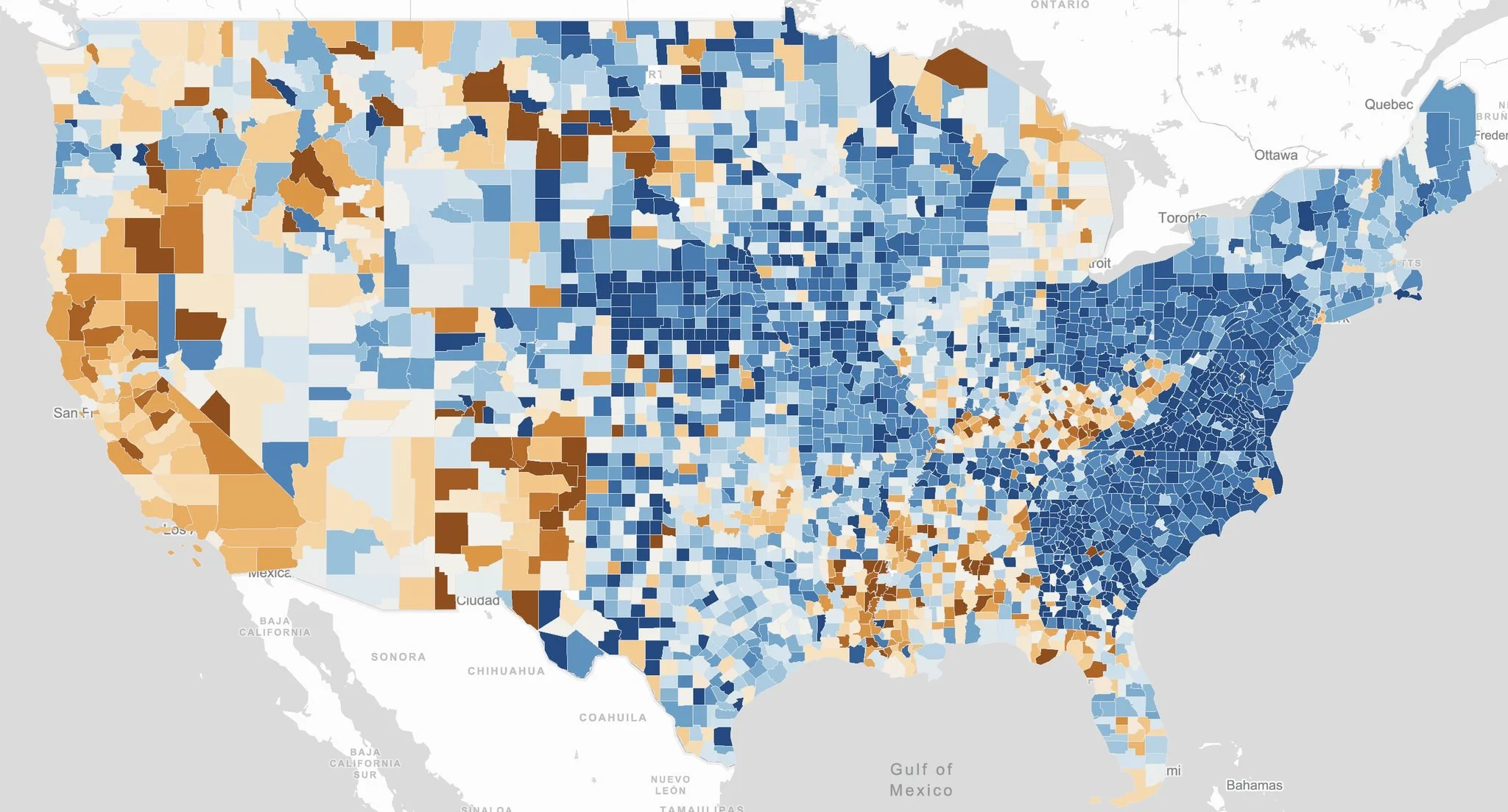
Yesterday on Facebook, Bob Morrison posted this map alongside the following text:
Ever wonder what music education across the country looks like? Here you go. The first-ever map of access to music education for the entire nation was compiled from the Arts Ed Data Project. This is a US map of COUNTIES. Each county is colored based on the percent of SCHOOLS offering music in that county. The darkest blue is 100%. The darkest orange is 0% or near 0%. Very light blue is 50%. What patterns do you see? HT to the extraordinary David Wish for his question several years ago. PS - It only took my team and I 20 years to build this! Special thanks to The Music Man Foundation, CMA Foundation, and the William and Flora Hewlett Foundation for the support to make this possible!
For those of you that don’t know Bob, he is a FORCE in music education. Bob is the Founder of Music for All, was the founding CEO of the VH1 Save The Music Foundation, served as the Director of Market Development for the NAMM, where he helped create the Mr. Holland's Opus Foundation and was recognized for his work add the arts as a core subject to the nation's education goals. He is the Founder and CEO of Quadrant Research, the nation’s leading arts education research organization, and a recognized pioneer in statewide arts education status and condition research. This map comes directly from his work on the Arts Ed Data Project.
In my opinion, this is the most important map in US music education history. Period. At first glance, this map is striking in its beauty. I LOVE infographics. A patchwork of blues and oranges spreads across the country, suggesting a nation rich with variation, diversity, and local identity. But as with so many data visualizations in education, the longer you look, the more uncomfortable questions begin to surface. This is not just a map of geography. It is a map of opportunity. And in many places, it is a map of absence. On a personal note, the county that I live in - Rockland County in New York - just north of New York City - is shaded light blue, meaning roughly half of the schools in my county do not offer music programs. Stunning. In a comment from Bob, replying to Music Will Founder, David Wish, Bob the map results up best:
This shows music for some... even music for many... There is work to do to get to... Music for All!
What the graphic makes immediately clear is that access to music education in the United States is deeply uneven. Large swaths of the Northeast and Midwest appear saturated with opportunity, places where music programs are consistently present and often well established. In contrast, significant regions of the South, Southwest, and parts of the West show far lighter coverage, signaling fewer or more fragile music offerings. These patterns are not random. They align closely with long standing disparities in school funding, population density, and socioeconomic status. Just look at this map of the country, west of the Mississippi RIver:
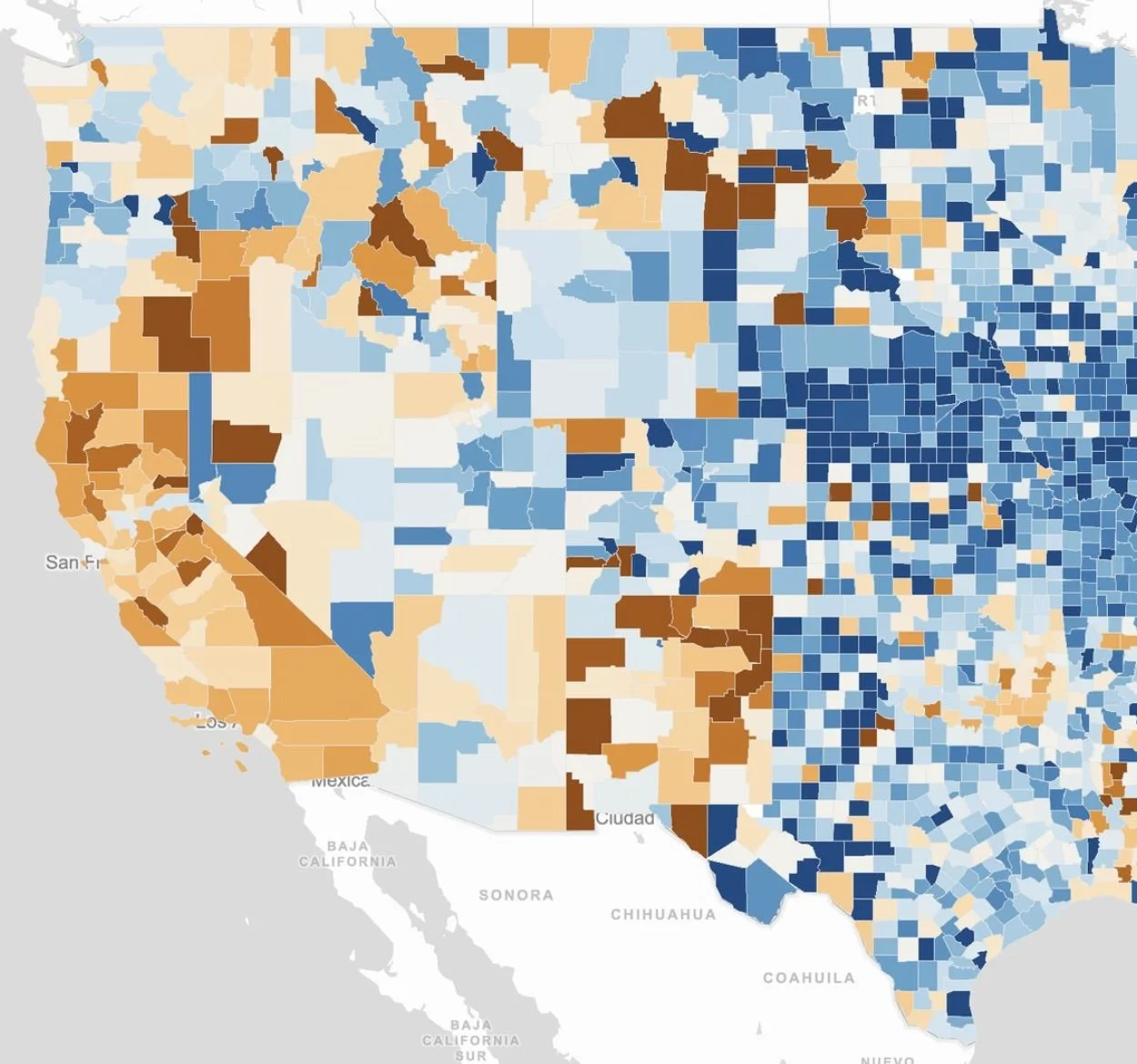
I don’t think there could be much more disparity here. On the one hand you have deep blues in Iowa, Missouri, Nebraska and Kansas, stretching down to pockets in Oklahoma and parts of Texas. On the other hand, parts of New Mexico, California, Nevada and Idaho are severely lacking. While California has taken HUGE steps in correcting that through Prop 28, what about the other states? For those of us who work in music education, this is both familiar and troubling. We know that access to music programs often depends on ZIP code rather than student interest or talent. We know that rural districts struggle to recruit and retain certified music educators. We know that schools serving high poverty communities are more likely to treat music as expendable when budgets tighten or testing pressures increase. This map does not introduce a new problem, but it does make that problem impossible to ignore.
What is especially important to recognize is that access is not the same as quality. Even in areas shaded more favorably, the presence of a music program does not guarantee adequate instructional time, appropriate class sizes, functional instruments, or pathways for continued participation. Conversely, in areas with limited access, individual teachers often perform heroic work to sustain programs with minimal resources. The issue is not commitment. The issue is support.
If we believe, as the research consistently shows, that music education contributes to academic achievement, social emotional development, and a sense of belonging, then this map should be a call to action. Improvement is most urgently needed in regions where students have little or no exposure to sustained music learning. That means investing in teacher preparation pipelines that serve rural and underserved communities. It means protecting music from being marginalized in scheduling and accountability systems. It means recognizing that access to the arts is not a luxury reserved for certain communities, but a fundamental part of a complete education.
Technology has a role to play here, but it is not a silver bullet. Digital tools can extend reach, provide supplemental experiences, and support teachers who are isolated or overextended. But they cannot replace the human relationships at the heart of music making. Real improvement requires policy decisions that value music education as essential, not optional.
Ultimately, this map challenges us to ask a simple but profound question. Are we comfortable with a system where a child’s access to music depends largely on where they happen to live? If the answer is no, then our work is clear. Equity in music education will not happen by accident. It will happen only when we decide, collectively, that every student deserves the chance to make music, no matter their address.
On a personal note, a huge BRAVO to Bob Morrison and all involved to create this incredibly important map. He says that he’s been working on it for 20 years, and it’s easy to see why. I urge all music educators to use data like this to imrpove the lives of the millions of students in K-12 schools today. We all know that music education drastically improves the oevrall education and experiences of students in our schools. It’s time that EVERY county turns dark blue. There is work to be done!