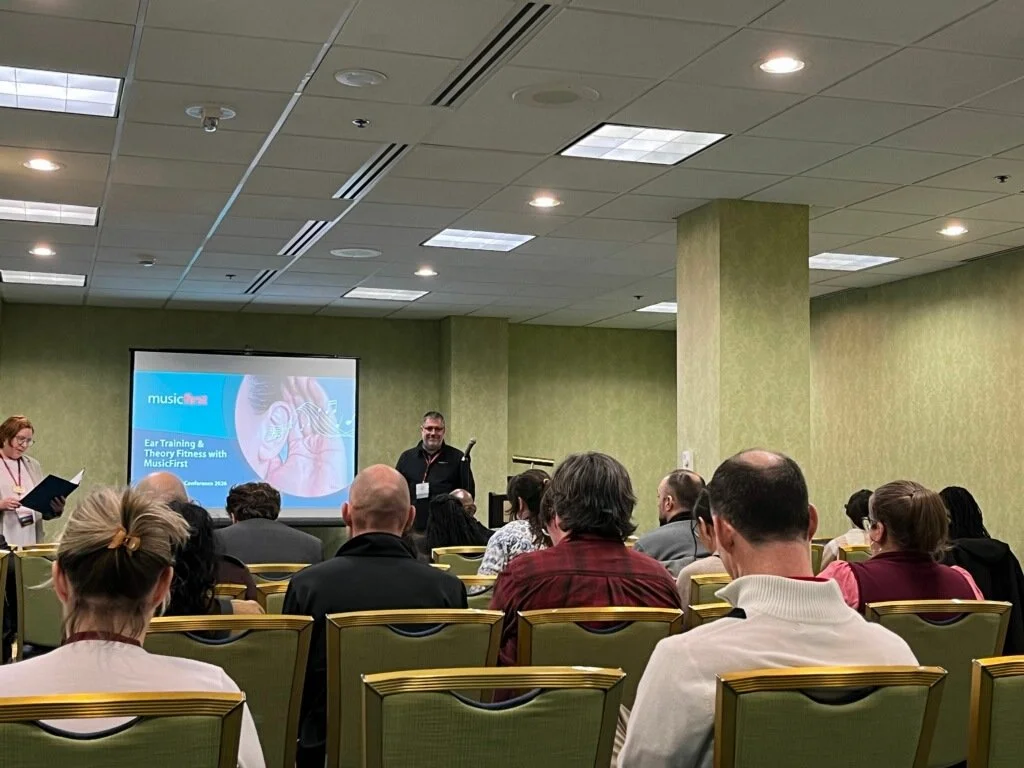
Yesterday at the 2026 Michigan Music Conference, I had the chance to present a session with a title that probably made a few people smile knowingly: “Ear Training and Music Theory: There’s An App for That.” It was a packed room, which tells me something important: music educators want to teach theory and ear training well, but time, logistics, and competing priorities often get in the way. The central challenge we talked about is one every director recognizes immediately. Rehearsal time is limited. Performance demands are relentless. And yet, we all know that ear training and music theory aren’t “extras.” They’re foundational skills that directly impact intonation, sight-reading, rhythmic accuracy, musical independence, and long-term student success.
So the session wasn’t about adding more to already crowded schedules. It was about making smarter use of the time we already have—and leveraging technology to do the heavy lifting. We began by reframing theory and ear training as rehearsal multipliers. When students can identify intervals, understand harmonic function, and hear rhythm accurately before they play it, rehearsals become more efficient and musical. Theory speeds up learning. Ear training strengthens ensemble awareness. Everyone wins.
From there, I introduced the MusicFirst Theory solution: MusicFirst Classroom as the central hub, paired with tools like AuraliaFirst for ear training, MusitionFirst for theory fundamentals, Flat for Education for composition and notation, and Focus on Sound for guided listening, vocabulary development, and yes, sub plans. Each tool serves a distinct purpose, but together they create a flexible, student-centered approach to musicianship.
The heart of the session focused on five easy, practical strategies that teachers can implement immediately:
Short warm-up snippets that use intervals or rhythm patterns
Flipped theory assignments that move instruction outside rehearsal
Creative ear-based tasks that combine listening, composing, and reflection
A consistent weekly “tech time” routine
Ensemble crossover activities that connect theory directly to repertoire
None of these strategies require massive curriculum overhauls. In fact, many teachers in the room nodded when we talked about using just three to five minutes a day. Small, consistent moments add up.
We also addressed common concerns: devices, homework, and time. The solutions were refreshingly simple: keep activities short, allow flexible access, and establish clear routines. Auto-grading and progress tracking remove the assessment burden, while students benefit from immediate feedback and a game-like sense of progress. I also looked at free apps that are out there, like MusicTheory.net and the fact that while they are often wonderful and convenient, the effort and time it takes to enter grades for student work defeats the primary purpose of using them. LOTS of nodding heads in the crowd.
If there was one takeaway I hoped attendees left with, it was this: you don’t need to do everything at once. Start with one tool. Try one strategy. Be consistent. Musicianship grows when we make it intentional—and thanks to today’s technology, yes, there really is an app for that.
And if yesterday’s conversations were any indication, this is a conversation worth continuing. If you’d like to try out our Music Theory Solution, just sign up HERE for a FREE 30-day trial.