Is Music Education In Danger in the Age of AI? Absolutely Not.
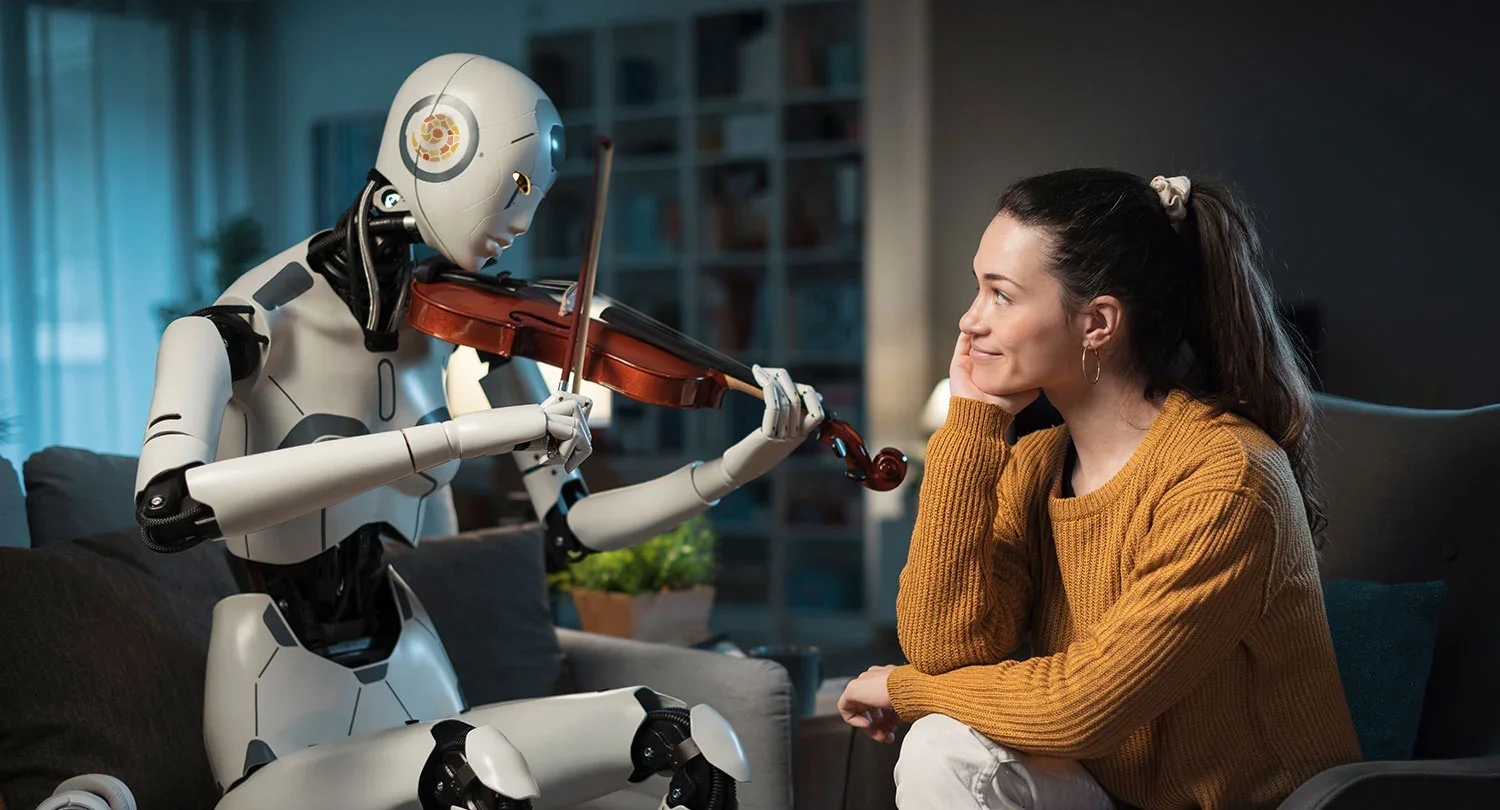
This past year has been filled with news surrounding AI - simultaneously both exciting and scary. I’ve had countless conversations with friends and colleagues about the potential impact on society and our future - and rarely do those conversations sound optimistic. They usually revolve around people losing their jobs, music being “dumbed down”, the danger of losing of our ability to be creative, and many more not-so-nice visions of that future. I’ve been thinking non-stop about this subject since I first sat down with ChatGPT three years ago. I’ve realized in that time that we’ve been here before - not with generative AI - but with technology in general. Every time a new technology breaks through, someone predicts the end of something we value. Radio was supposed to kill live performance. Synthesizers were supposed to eliminate orchestras. Television and the internet were supposed to reduce the need for teachers. And now, AI is supposedly threatening education. I’ve heard music teachers (mostly private lesson teachers) talk about being replaced by robots or software that can teach students with unlimited patience and knowledge. In my opinion, the narrative is dramatic but completely backwards. Far from diminishing the importance of education, AI makes it more essential. Music strengthens the exact human skills that students will need most in the future: creativity, collaboration, adaptability, empathy, and the ability to make meaning from complexity. These aren’t just “nice-to-have” attributes, they’re the traits employers consistently name as the most valuable in an evolving, AI-saturated workforce. And more importantly, they are the qualities that make us distinctly human.
AI excels at pattern recognition, speed, efficiency, and prediction. What it can’t do is create with intention, connect emotionally, or collaborate in a way that feels alive. That’s the domain of humans - and from my perspective - musicians. Students who study music learn how to solve problems creatively; shaping a phrase, adjusting their intonation, interpreting notation, or improvising harmonically. They learn collaboration by rehearsing in ensembles, where listening, empathy, and nonverbal communication are required every second. They build adaptability by responding to conductors’ cues, balancing with peers, or adjusting to the acoustics in an unfamiliar space. And of course, they learn discipline and focus, two skills that will always be prized no matter how automated our world becomes.
These aren’t abstract benefits. They’re real world competencies that correlate directly to emerging careers in creative technology, human-AI collaboration, media production, and fields we haven’t conceived of yet. The future belongs to people who can imagine, interpret, lead, and inspire. Music students already do that.
One of the most important things to remember in discussions about AI is that new technologies often feel revolutionary, but rarely change day-to-day human behavior as dramatically as predicted. The internet didn’t make us entirely different people, it just made it easier to get information and to buy things. Streaming didn’t change the essence of music making; it changed how we access recordings. AI will follow the same pattern. It will accelerate some tasks, automate others, make information even more accessible, and make certain creative workflows faster. But the core human behaviors: curiosity, exploration, community, and expression won’t fundamentally change. Music teachers won’t be replaced for the same reason that books weren’t replaced by Kindles: the human experience of learning and doing is irreplaceable. I, for one, MUCH prefer holding a book in my hand - even though I can access it so many other ways. Call me old school, but I think kids are the same as well. Look at the method books that we use with our beginner musicians. Is anything as perfect or convenient as opening up a paper book and writing instructions on the page for the students? That’s why they’re still printing millions of method books a year. Often the thought of the technology advance is better than reality. Ask any music teacher what they would prefer to see on the music stands in front of their students - a piece of paper or a Chromebook. Because we’ve taught kids, the choice is obvious! How many kids would knock over the stands with the Chromebook on it on the first day? Does anyone really think that AI can come up with a better way of disseminating music to our students?
I recently had a discussion with a colleague about the Ray Kurzweil lecture I blogged about a few weeks ago, and was telling him how impactful and straight up scary his predictions about the future were. He told me to read a book by Nick Foster titled Could, Should, Might, Don’t: How We Think About The Future. I’m SO glad I did. The book offers a brilliant framework for understanding how we approach new technologies—one that applies perfectly to AI. Foster encourages designers and thinkers to ask four essential questions: What could we build? What should we build? What might happen if we do? And what shouldn’t we attempt at all? In my opinion, this mindset is exactly what music educators need as AI becomes more integrated into our work.
What AI could do is enormous: create exercises, analyze playing, generate accompaniments, give personalized practice guidance, and even compose convincing music. But those possibilities aren’t the same as necessities.
What AI should do is support teachers, not replace them. It should amplify student creativity, not diminish it. It should make practice more engaging, assessment more precise, and learning more personalized. When used thoughtfully, AI becomes a supportive partner, never a substitute.
What AI might do (if adopted with care) is open new avenues for exploration. Imagine students collaborating with AI tools to orchestrate, improvise, or create multimedia performances. AI could democratize access to high-level musical experiences for students who may not otherwise have them.
And what AI must not do is attempt to replace the deeply human act of making music together. It shouldn’t remove struggle, discovery, nuance, or the emotional journey that music education provides.
Foster’s perspective, one that I completely buy into, reminds us that technological capability doesn’t dictate educational value. Music educators get to decide which uses of AI align with our mission and which do not.
As AI takes over more routine tasks, the uniquely human qualities musicians embody: feeling, connection, and empathy become more valuable, not less. When a choir finally creates that perfect blend, when your jazz band soloist improvises a solo and it sounds great, when a student beams after nailing a challenging passage; these moments enrich students’ lives in ways that no algorithm can replicate. They remind us why we teach, why music matters, and why our programs remain essential. AI can analyze performances, but it cannot care about them. It can generate a melody, but it cannot feel pride or awe. It can provide feedback, but it cannot inspire. Music educators can.
History shows that technology rarely destroys the things that make us human. Instead, it gives us new tools to express who we already are. AI is no different. It won’t replace music education; it will reinforce its value. I really think I’m right on that. While I don’t think for a second that everything that is to come will be good for education or humanity for that matter, history teaches that technological innovations don’t always have the impact that the companies making those products do. remember the Segway? It was supposed to revolutionize transportation. Now it’s what tourists do to look really silly while rolling around the sites (sorry). When it comes to the impact of AI on music education, I think it’s no different. Parents will want to go to their child’s concerts, bring them to marching band rehearsals, drive them to an All State audition, sit in the audience for the school musical - all of it. Humans are inherently resistant to change and I think that AI will face that same challenge. They’re even more resistant when it has the potential to change how we live our day to day lives, and how we interact with each other. In the age of artificial intelligence, students will need creativity, collaboration, empathy, and adaptability more than ever. Music is one of the few disciplines that teaches all of these at once. So no; music education is absolutely not in danger. If anything, the future will need more musicians, more music teachers, and more opportunities for students to experience the joy of making music together. And that’s something no technology can change.